
As described by the Bat Conservation Trust:
“Passive acoustic monitoring involves deploying sound recorders into the field for a certain length of time to monitor wildlife and their acoustic surroundings. This offers a non-invasive and affordable way to collect large quantities of data and can provide many insights for bat conservation.”
What you need to do
Placement of bat detectors will depend on your aims, resources, and time.
Placement along linear features (e.g. hedgerows, lines of trees) may target a higher diversity of
species, as bats use these as flightpaths.
On the other hand, you may wish to sample a variety of habitats for comparison.
A 5-night period is usually sufficient to collect a substantial amount of data, while allowing for adverse weather conditions that may impact recording quality and bat activity. This can be extended on a night-by-night basis under periods of prolonged adverse weather.
You may wish to deploy:
- Once a year – ideally in the peak activity period of May to August
- Once per season – covering spring (April/May), summer (June – August), and autumn (September/October)
- Monthly – between April and October
- At multiple locations - either simultaneously or within the same month, ideally, or seasonal period (as above).
Consistency is key. Should the survey be replicated in following years, deployment should take place at as close to the same time and same location each year, for reliable comparison of bat activity. At the very least, year-on-year deployment should be within the same season each time.
Note: The professional guidelines for bat surveyors require a monthly 5-night deployment between April – October. Further information can be found on the Bat Conservation Trust website: Bat Surveys for Professional Ecologists: Good Practice Guidelines 4th edition - Guidance for professionals - Bat Conservation Trust
Types of bat recorders
| Model | Brand | Estimated Cost | Pros | Cons |
|---|---|---|---|---|
| Audiomoth*** | Open Acoustic Devices | £75 | Very small. Much cheaper. | Ships from US. Less water-resistant. Less power at higher frequencies. |
| Song Meter. Mini Bat/Mini Bat 2* | Wildlife acoustics | £750 | Smaller and lighter than SM4. Connects to an app for setup/status check. In-built microphone. | Less power than SM4 Bat. |
| Song Meter SM4 Bat** | Wildlife acoustics | £1,200 | Higher detection capability. Robust device | Requires external ultrasonic microphone. |
* https://www.wildlifeacoustics.com/products/song-meter-mini-2-bat-aa
**https://www.wildlifeacoustics.com/products/song-meter-sm4bat
***https://www.openacousticdevices.info/audiomoth
Setup
Many environmental factors can interfere with or ‘drown out’ your bat recordings. Factors to consider include:
- Place detector at least 1.5m from flat surfaces and vegetation or loose materials that may rustle in the wind.
- Ensure the microphone is facing upwards and outwards as much as possible, and not obstructed.
- Sound can bounce along branches, stakes and other objects that detectors may be attached to. Ensure microphone is clear of these and exposed (as in the example below, microphone marked with red arrow).
- Elevation of detector on a stake, tree, or fence post, for example, will increase detection but height need not be higher than your access capabilities.
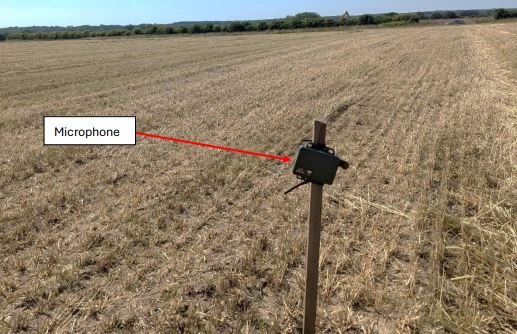
Photo credit: Wild Frontier Ecology Ltd
Note: Speech recorded by bat detectors can be replayed in real-time.
Data handling
Raw data can be processed by the BTO Acoustic Pipeline, an auto-classifier that will ID bat calls to species. The pipeline is usable on a pay-as-you-go basis, with the first 100 credits free. This will allow you to process 100gb of data, which should be plenty for a small project. Additional credits can be purchased at a rate of £50 + VAT for 250 credits (to process 250gb of data for citizen science projects).
Useful information
BTO pipeline returns a datasheet of calls matched to a species ID and certainty of ID accuracy.
You may wish to compare abundance and diversity of species by looking at call numbers at one
location, or to compare total bat calls/ calls per species across multiple locations. These
results can be compared year-on-year if the study is replicated using the same location and
matching the study period as closely as possible.
Further information on the bats you may record can be found on the Bat Conservation Trust
website: UK Bats - Types of bats - Bat Conservation Trust
Questions or problems?
Get in touch and we'll help you get set up.